Find out about clinical trials for investigational CAR-T therapy in lupus, myositis, diffuse cutaneous systemic sclerosis, and vasculitis.
Participation in clinical trials is voluntary. You are free to withdraw from the trial at any time.
Investigational CAR-T therapy is specific to each patient. It is designed to remove the B cells that drive autoimmune diseases, potentially helping the body replace them with healthy ones. 1
In our clinical trials, we’re studying investigational CAR-T cell therapy to see if it could offer long-lasting control in autoimmune diseases. 1
Sometimes called systemic lupus erythematosus or SLE, and lupus with kidney inflammation also known as lupus nephritis or LN.
In lupus (or systemic lupus erythematosus – SLE, and lupus nephritis – LN), the immune system attacks a range of organs, most commonly the kidneys.3
B cells are known to play a key role in the way lupus works, so investigational CAR-T therapy could be an effective treatment.1, 3
We are investigating CAR-T therapy in lupus to see if it can improve people’s symptoms.
In this group of rare autoimmune disorders, the immune system attacks the muscles and other internal organs.
Myositis (or idiopathic inflammatory myopathy – IIM) is a group of rare autoimmune disorders in which the immune system attacks the muscles and other organs, such as the skin, lungs and joints.4
B cells are believed to play a major role in IIMs,5 and by targeting those B cells, investigational CAR-T therapy is thought to have the potential to become an effective treatment option.
Here, the immune system attacks connective tissue, causing fibrosis (scarring) of the skin and organs.
In diffuse cutaneous systemic sclerosis (or dcSSc), a subtype of scleroderma, the immune system attacks connective tissue, causing fibrosis (scarring), affecting the skin and internal organs, particularly the lungs.6
B cells have been found to be a key factor in the cause of scleroderma.7 This means investigational CAR-T therapy could be a potential treatment option. Investigational CAR-T therapy is being studied in people with dcSSc.
Also known as ANCA-Associated Vasculitis or AAV.
ANCA-Associated Vasculitis (or AAV) is a type of systemic vasculitis. In AAV, the immune system attacks small or medium blood vessels, which can severely affect a range of organs such as the lungs and kidneys.8
B cells are known to play a key role in AAV.8 This means that investigational CAR-T therapy could be a potential treatment option.8 Investigational CAR-T therapy is being studied in people with two specific subtypes of AAV: granulomatosis with polyangiitis (GPA) or microscopic polyangiitis (MPA).
It is hoped that investigational CAR-T therapy could help control symptoms for longer and avoid organ damage.9
When our immune system is working properly, it protects us from pathogens and other harmful substances. But in autoimmune diseases the immune system starts to attack the body’s own healthy organs and cells.1
But in people with autoimmune diseases, B cells produce antibodies that mistakenly attack their own healthy organs too.

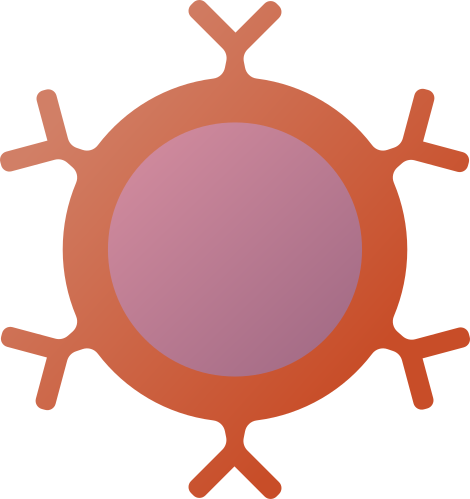
T cells are responsible for identifying and removing infected or abnormal cells.
Some T cells directly remove these infected or harmful cells, others help guide the immune system to deal with them.
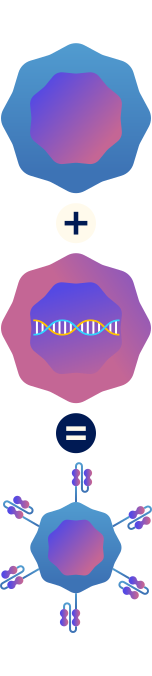
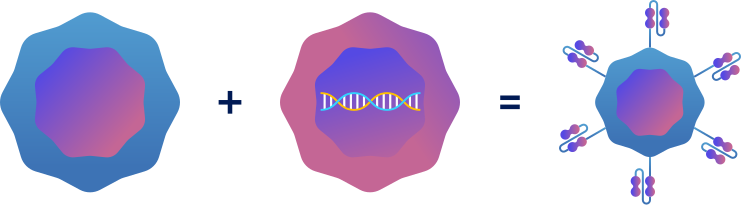
Investigational CAR-T therapy is personalized to each patient. It reprograms a person’s own T cells to target the harmful B cells in the body.1
A person’s blood is taken, and their T cells are collected. These T cells are given ‘chimeric antigen receptors’ (or CARs), turning them into CAR-T cells.1 In our trials, these CAR-T cells are configured to recognize and remove harmful B cells. The CAR-T cells are returned to the patient’s body where they target the B cells causing the autoimmune disease.1 The body can then potentially replace the abnormal B cells with correctly working ones.1
This may give people who have relied on long-term medications the possibility to see if sustained improvement of their disease and improved quality of life could be achieved with a once-only CAR-T infusion.1
Personalized medicine and investigational CAR-T therapy is a key focus area of research for Novartis.
We are running four Phase II clinical trials for investigational CAR-T therapy called the AUTOGRAPH trials. They are designed to evaluate the safety and effectiveness of investigational CAR-T therapy in four autoimmune diseases – Lupus (SLE/ LN), myositis (IIM), diffuse cutaneous systemic sclerosis (dcSSc), and vasculitis (AAV).
In some of these trials, we will be researching the safety and effectiveness of investigational CAR-T therapy compared to commonly used treatments. So, in these types of trials, it is possible you will not receive the investigational product if you participate.
Clinical trials (or clinical studies) are more than just research. They are an essential part of developing new medicines and thousands of people around the world participate every year. Everyone involved in a clinical trial is helping shape the future of care.
They’re a type of medical research that human volunteers take part in, and help us find out important information about a drug, device, test, or procedure, such as:
Clinical trials can offer patients access to potentially innovative therapies with care and monitoring for the duration of the clinical trial.
More information about clinical trials is available in this clinical trials booklet.![]()
The investigational CAR-T therapy that we are studying is designed to reshape a person’s own immune system to target harmful B cells that contribute to autoimmune disease. It is a personalized therapy created from each patient’s own immune cells. 1
These clinical trials are looking to see if people who have been relying on the long-term use of other medications may be able to experience sustained improvement of their disease and quality of life with a once-only CAR-T infusion.1
The AUTOGRAPH trials are Phase II trials to learn about Novartis’s investigational CAR-T therapy.
We are investigating its safety and effectiveness, to see if it can help improve the lives of people with severe or refractory autoimmune diseases. Throughout the trial your autoimmune disease will be monitored to see if it has improved after treatment. Your overall health will also be monitored to make sure you aren’t having any side effects.
There are four separate trials, each looking at Novartis’s investigational CAR-T therapy in autoimmune diseases which are known to involve B cells. These are Lupus (SLE / LN), myositis (IIM), diffuse cutaneous systemic sclerosis (dcSSc), and vasculitis (AAV).
Overall, the AUTOGRAPH clinical trials will last for up to 6 years, depending on which trial you enroll in. The trials have several stages. If you are receiving investigational CAR-T therapy, the stages will be:
We are looking for people to take part in clinical trials for Novartis’s investigational CAR-T cell therapy. To be included we need people who, among other criteria:
For more information about the trial and other eligibility criteria, see the links below. If you aren’t sure if this applies to you, please contact your doctor or the study team for more information. The team will look at your full medical history to help you find out if the trial is right for you. You won’t be committing to join a trial.
To find out more about the AUTOGRAPH CAR-T therapy clinical trials, and to contact a site to see if you are eligible, click one of the links below:
Clinical sites may be able to support study participants financially and with travel so that we can ensure patients have the easiest experience possible. They may be able to support with travel coordination, compensation for study visits and visit-associated expenses.
Reimbursement policies vary by site and are subject to ethics approval. Speak to the study team for more detailed information on support that may be available to you.
If you choose to and are eligible to join an investigational CAR-T therapy trial, your study team will clearly explain everything you need to know. Here’s a quick overview of the main steps involved in the trial, among others:
During a process called ‘leukapheresis’, your blood is collected so your T cells can be separated from your blood by a machine. The rest of your blood is then returned to your body.
Your T cells are sent to a lab where they are reconfigured so they can target the harmful B cells. The changed cells are called CAR-T cells.
Next, your body needs to get ready for the investigational CAR-T cells. In a process called ‘lymphodepletion’, you’ll be given an infusion of medicine designed to reduce the number of white blood cells in your body so there is space for the new investigational CAR-T cells.
We’ll start by giving you some premedications. You’ll then be given the investigational CAR-T cells through an infusion.
You will need to stay in the hospital for 2 weeks so we can closely monitor your health and make sure you’re doing well. For the following 2 weeks you’ll need to stay less than 2 hours away from the hospital or study clinic.
When you’ve finished the trial you’ll be asked if you want to join a long-term follow-up study. If you do, we will monitor you to see the long-term effects of investigational CAR-T therapy.
Caring for a person with an autoimmune disease is a vital role, and important to the success of a person’s treatment.
As part of the clinical trial, the person receiving the investigational CAR-T therapy will need to remain in hospital for 2 weeks after the infusion. They will then need to stay within 2 hours travel from the hospital for a further 2 weeks. It’s important you’re aware of this as they may need your support during this time.
These are the key ways that carers can help:
Understanding
Help your loved one understand what will happen during the clinical trial and raise any questions with the study team.
Monitoring
Watch for any changes in how they feel and share these with the healthcare team.
Emotional support
Being present, listening, and helping them manage stress can make the process easier.
Transport
You may need to help with getting to appointments and keeping track of schedules.
Remember, support is always available if you need it.
The AUTOGRAPH clinical trials will evaluate whether investigational CAR-T therapy could help reshape your immune system to target harmful autoimmune activity.1
To find out more about the AUTOGRAPH CAR-T therapy clinical trials and whether you might be eligible, choose the condition that applies to you from the links below.
A member of the study team will be able to explain the study in simple terms and look at your full medical history to help you find out if the trial is right for you. You won’t be committing to join a trial.
Do I have to take part in the clinical trial?
No, you can contact a study team to find out more information without committing to taking part in a clinical trial.
If you are interested, your study team will discuss the risks and benefits with you before you make your decision. As a volunteer you can choose to leave at any time without any penalty or loss of medical benefits.
What are the potential benefits of participating?
Investigational CAR-T therapy is a once-only infusion that targets the cells that are responsible for autoimmune diseases.1
We are investigating CAR-T therapy to see if it can continue to eliminate these harmful cells, long term. This may thereby take away the need for lifelong medication.1
With the potential for symptom relief without ongoing medication, investigational CAR-T therapy may give people with autoimmune diseases an improved quality of life.1,8
As part of the clinical trial you will receive frequent health assessments and monitoring. All study-related care will be provided at no cost.
What’s more, people who participate in clinical trials have the opportunity to help shape the future of care and grow our understanding of potential new treatments.
What are the potential risks of participating?
Will the study affect my current treatment plan?
Details of this will need to be discussed with your doctor and the study team. There are some treatments that cannot be taken whilst on the trial.
You may need to stop taking your current treatment before your T cells are collected. This is called a washout period. The study team will support you to make sure this is done as safely as possible.
If you are receiving a class of medicine known as GCs (glucocorticoids), such as prednisone or dexamethasone, you may need to reduce your dose.
Will I have to take time off work?
Maybe. Study participants will need to stay in hospital for 14 days after their investigational CAR-T therapy is given. After that you will need to stay within 2 hours travel time from the hospital for the next 2 weeks. This may have an impact on your ability to go to work. It may help to talk to your employer about flexible working or medical leave. The study team can help if you need support with these conversations.
Will I have to avoid certain activities while taking part in the study?
Participants will need to avoid driving or operating heavy machinery for 8 weeks after receiving investigational CAR-T therapy.
We do not know whether the study treatment(s) may harm an unborn or nursing baby. If you are pregnant, trying to become pregnant, or breast-feeding, you cannot be in the study.
There are requirements for contraception for both female and male participants from the time they join and for at least two years after receiving the investigational CAR-T therapy.
Also, cyclophosphamide (used as one of the pretreatment drugs for lymphodepletion) can affect male and female fertility. Your study team will discuss your potential options for fertility preservations, including risks and outcomes.
Participants should not donate blood, organs, tissues, sperm, eggs or other cells after receiving investigational CAR-T therapy.
Is there an investigational CAR-T cell therapy study site near me?
We are recruiting participants for these clinical trials in sites across the US. To find out more, and to find the nearest site to you, or a site that it may be convenient to travel to, visit the clinical trial page for the condition that applies to you:
What support will I receive while I am being treated at the treatment center?
Throughout the whole process you will be closely monitored by the study team.
Costs incurred during clinical trial participation such as travel, lodging and meals may be reimbursed. In some cases, it may also be possible to reimburse childcare. Additionally, if a caregiver is attending study visits, they may also be reimbursed for costs associated with travel and expenses incurred.
Reimbursement policies vary by site and are subject to ethics approval. Speak to the study team for more detailed information on support that may be available to you.
Is there a cost to participate in the study?
No. Participants will receive investigational CAR-T therapy and study-related medical care and assessments at no cost.
You will not have to pay for any study treatment(s) or any study-related tests or procedures while you are participating in the study. However, the Sponsor will not pay for the costs of the usual care you need to maintain your health.
We understand that taking part may lead to other costs, such as time off work. Support from the study sponsor may be available to help with this.
Will there be reimbursement for travel to the study site?
Novartis may be able to support with travel coordination, compensation for study visits and visit-associated expenses. Policies vary by site and are subject to ethics approval. Speak to the study team for more detailed information on support that may be available to you.
The name given to the clinical trials for Novartis’s investigational CAR-T therapy.
A group of diseases in which a person’s immune system attacks their own body.
A type of white blood cell that helps protect your body by making antibodies. In some diseases, B cells can become overactive or damaged, which is why treatments like CAR-T cell therapy may target them.
A special protein added to your T cells in the lab so they can recognize and attach to certain cells in your body. This change helps your T cells find and destroy the diseased cells once they are infused back into you.
Your own immune cells (T cells) that have been modified in a lab to recognize and target the harmful B cells.
Natural chemical messengers made by immune cells that help them communicate.
Medicines like prednisone that reduce inflammation and are sometimes tapered down slowly.
When medicine or CAR-T cells are given slowly into a vein (through an IV or a central line).
A procedure where some of your white blood cells (T cells) are collected from your blood using a special machine. The rest of your blood is returned to your body. These cells are later changed in the lab to make CAR-T cells.
A short course of chemotherapy given before your investigational CAR-T therapy infusion to make space in your immune system and help the new investigational CAR-T cells work better.
A small group of atoms forming building blocks that make up the body.
Regular checks, tests, and visits done by the study team to follow your health and safety during and after treatment.
An organism, e.g. bacteria, virus, or fungus, that can cause an infection.
The stage of a clinical study where a treatment is given to a larger group of people (often 50–200) to test how well it works and to learn more about its safety.
Describes a disease which is not responding well to treatment.
Whether a therapy, treatment, or medicine has side effects or adverse events, what the side effects are, and how serious they are.
Describes a disease that is very bad or intense and which has a major impact on daily life.
An unwanted or unexpected reaction to a medicine or treatment, such as fever, nausea, or tiredness. Some are mild and temporary, while others may need medical care.
The group of doctors, nurses, coordinators, pharmacists, and other professionals who manage the study and patient care.
A type of white blood cell that helps your body fight infections and diseases. In investigational CAR-T therapy, your own T cells are collected and changed in a lab so they can better recognize and attack harmful cells.
A group of cells that combine together to form a bigger structure e.g. an organ, muscle, or tendon
For more information about Novartis clinical trials for patients and caregivers, please visit our Novartis website
We do not sell data to third parties. Data you submit is handled according to our Privacy Policy and web site use agreements.
To control data you have already submitted, or to log a do not sell data request, make a data request here.
To control data you have already submitted, make a data request here.
Data you submit is handled according to our Privacy Policy and web site user agreements.