
Treating myositis can be challenging because it can have an effect on so many organs around the body. Treatment options usually start with medicines that reduce the immune activity,
but some people experience side effects that they’re unable to tolerate.
Others may not respond as hoped.
Or they respond well but then find that their medication no longer gives them the same benefits.
So, there is a significant need for targeted and more effective treatment options for people with myositis.
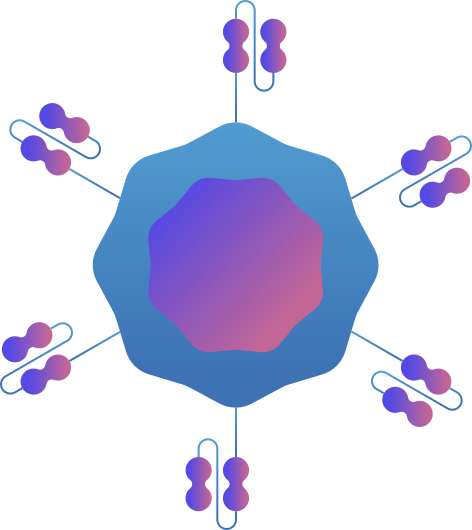
Investigational CAR-T therapy is being tested and is not yet FDA-approved, so there is no guarantee there will be a personal benefit.
Myositis (or idiopathic inflammatory myopathy – IIM) is a group of rare autoimmune disorders in which the immune system mistakenly attacks the body’s own muscles and other internal organs.2



The modified cells are then returned to your body in a one-time infusion. These trials are testing the safety and effectiveness of investigational CAR-T therapy in people with myositis.
The aim of the AUTOGRAPH-IIM clinical trial is to study how safe investigational CAR-T cell therapy is and how well it works compared with existing treatment options...
The aim of the AUTOGRAPH-IIM clinical trial is to study how safe investigational CAR-T cell therapy is and how well it works compared with existing treatment options.
Researchers are looking to see if people with IIM who have been relying on the long-term use of other medications may be able to experience sustained improvement of their disease and quality of life with a once-only CAR-T infusion × Infusion When medicine or CAR-T cells are given slowly into a vein through an intravenous (IV) or central line. .
Information from this trial may help improve future treatment options for people with IIM.
This overview introduces the purpose of the trial. More detailed information is provided in the sections that follow.
This is a Phase 2 × Phase 2 (clinical trial phase) The stage of a clinical trial where a treatment is given to a larger group of people (often 50–200) to investigate how well it works and to learn more about its safety. trial, meaning we are investigating the safety and effectiveness of investigational CAR-T × CAR-T cell Your own immune cells (T cells) that have been modified in a lab to recognize and target harmful B cells. cell therapy compared with commonly used treatments. Not everyone in the trial will receive investigational CAR-T therapy, some people will receive existing treatments so we can compare any changes fairly...
This is a Phase 2 × Phase 2 (clinical trial phase) The stage of a clinical trial where a treatment is given to a larger group of people (often 50–200) to investigate how well it works and to learn more about its safety. trial, meaning we are investigating the safety and effectiveness of investigational CAR-T × CAR-T cell Your own immune cells (T cells) that have been modified in a lab to recognize and target harmful B cells. cell therapy compared with commonly used treatments. Not everyone in the trial will receive investigational CAR-T therapy, some people will receive existing treatments so we can compare any changes fairly.
If you choose to take part in this trial, you may receive either:
The trial team will explain the available options and how treatment decisions are made before you decide whether to take part.
Clinical sites may be able to support you financially and with travel so that we can ensure patients have the easiest experience possible. They may also be able to support with travel coordination, compensation for trial visits, and visit-associated expenses...
Clinical sites may be able to support you financially and with travel so that we can ensure patients have the easiest experience possible. They may also be able to support with travel coordination, compensation for trial visits, and visit-associated expenses.
Reimbursement policies vary by site and are subject to ethics approval. Speak to the trial team for more detailed information on support that may be available to you.
Clinical trials (or clinical studies) are more than just research. They are an essential part of developing new medicines and thousands of people around the world participate in them every year...
Clinical trials (or clinical studies) are more than just research. They are an essential part of developing new medicines and thousands of people around the world participate in them every year.
Everyone involved in a clinical trial is helping shape the future of care.
Clinical trials are a type of medical research that human volunteers take part in, and help us find out important information about a medicine, device, test, or procedure, such as:
Clinical trials can offer patients access to investigational therapies with care and monitoring × Monitoring Regular checks, examinations, and visits done by the trial team to follow your health and safety during and after treatment. for the duration of the clinical trial.
More information about clinical trials is available in this clinical trials booklet .
Assessments are carried out to make sure that you and the trial are a good fit





Assessments are carried out to make sure that you and the trial are a good fit
You’ll be given your investigational treatment in a one-time infusion into the vein
If you choose to enroll, the trial will require a time commitment and ongoing involvement. This includes attending trial visits, following trial-specific treatment guidance, and planning for follow-up over several years.
This may have an impact on your ability to work. It may help to talk to your employer about flexible working or medical leave. The trial team can help if you need support with these conversations.
It is not known whether the trial treatment(s) may harm an unborn or nursing baby. If you are pregnant, trying to become pregnant, or breastfeeding, you cannot be in the trial.
Cyclophosphamide (used as one of the pre-treatment medications for lymphodepletion) can affect male and female fertility. Your trial team will discuss your potential options for fertility preservations, including risks and outcomes.
Caring for a person with myositis is a vital role, and important to the success of a person’s treatment.
As part of the clinical trial, the person receiving the investigational CAR-T therapy will need to remain in hospital for 2 weeks after the infusion. They will then need to stay within 2 hours’ travel from the hospital for a further 2 weeks. It’s important that you’re aware of this as they may need your support during this time.
Help your loved one understand what will happen during the clinical trial and raise any questions with the trial team.
Watch for any changes in how they feel and share these with the healthcare team.
Being present, listening, and helping them manage stress can make the process easier.
You may need to help with getting to appointments and keeping track of schedules.
Before anything else happens, you’ll meet with the trial doctor (also called the principal investigator). They will explain the purpose of the trial and who may be able to take part.
The trial team will share the informed consent form and other helpful materials, including short videos. These explain what taking part involves, the possible risks and benefits, and the time commitment.
Informed consent means you take time to learn about the trial, ask questions, and decide whether you want to take part. If you choose to continue, you’ll sign the consent form to confirm that you’re joining voluntarily.
After giving informed consent, you’ll go through a screening process. This helps the trial team check whether the trial is a good and safe fit for you.
Screening may include a review of your medical history, physical exams, and medical assessments. The goal is to confirm that you meet the trial’s requirements and do not have any conditions that would make participation unsafe.
The trial team will explain each step and answer any questions you may have.
If screening shows that you meet all trial criteria, you may be enrolled in the trial. The trial site will confirm your eligibility and guide you through the next steps.
Being enrolled means you can move forward in the trial, but participation remains voluntary throughout. You can choose to stop taking part at any time.
After you contact a trial site, the trial team
×
Trial team
The group of doctors, nurses, coordinators, pharmacists, and other professionals who manage the trial and patient care.
will guide you through a screening process to see if the trial is a good and safe fit for you.
This includes reviewing the informed consent form, your medical history, and doing routine exams and health assessments, such as blood and urine tests, vital signs, and heart checks.
If screening shows that you don’t qualify, the trial team will explain why, answer your questions, and talk with you about other care or research options.
Find out more about eligibility or contact a trial team here. By requesting more information, you won’t be committing to join a trial.
Yes. This trial is unblinded, which means both you and your trial doctor will know which treatment you are receiving. Some trial staff who assess your disease during the trial will not know which treatment you’re on. This helps keep the trial results as fair and accurate as possible.
In most cases, yes. Visitor policies depend on the hospital, so rules may vary. Because your immune system may be weaker, visitors might need to follow safety measures such as wearing masks or washing their hands carefully. Your trial team can explain the visiting hours and any guidelines you or your visitors will need to follow.
No. If you are not receiving the investigational CAR-T therapy, you will continue with safety and effectiveness follow-up visits while receiving the comparison treatment. There is no planned hospital stay for people in this part of the trial.
For more information about Novartis clinical trials for patients and caregivers, please visit our Novartis website.
To learn more about autoimmune diseases, please visit these independent patient advocacy organizations:
To control data you have already submitted, make a data request here.
Data you submit is handled according to our Privacy Policy and web site user agreements.
We do not sell data to third parties. Data you submit is handled according to our Privacy Policy and web site use agreements.
To control data you have already submitted, or to log a do not sell data request, make a data request here.


